
Areas We Cover
Commercial Recycling in Thamesmead
For businesses in Thamesmead, the best recycling results come from one habit: keeping each material separate from the start. We'll help you set that up.
- Separate streams for paper, card, plastic and metal
- Better rebates for clean material
- A short drive from our Erith yard
 Licensed Waste Carrier
Local service
Separation is where the value is
Whatever a business in Thamesmead produces, what it's worth depends on how clean and well sorted it is when we collect it. Paper mixed with plastic, or cardboard soaked in a general waste bin, loses value quickly, and in some cases turns a material we'd pay for into one that costs money to dispose of.
So our first conversation with a Thamesmead customer is usually about streams: which materials you produce, which ones are worth keeping apart, and what containers will make separating easy for your staff. Thamesmead is a short drive from our Erith yard, and we can co-ordinate several streams so separating doesn't mean extra hassle.
Services
Streams we collect in Thamesmead
Paper
Keep office paper away from food, laminates and waxed coatings and it stays a valuable grade. Shredded paper is accepted too. Paper recycling
Cardboard
A dedicated cardboard bin or stillage keeps it dry and clean, which is what earns a rebate rather than a charge. Cardboard recycling
Plastic
Film and rigid plastics are best kept in separate containers, with different rigid grades apart from each other where possible. Plastic recycling
Metal
Separated copper, brass, aluminium, stainless and clean steel are all worth significantly more than a mixed skip. Metal recycling
General waste
Whatever is left after separation goes in its own container and is sorted again at a licensed partner before energy recovery. General waste
Consultancy
We can visit, look at what you throw away, and recommend which streams are worth separating at your premises. Environmental consultancy
Who it's for
Who we collect from in Thamesmead
We work with a range of Thamesmead organisations, including:
- Offices and business units
- Light industrial and manufacturing premises
- Retail and trade businesses
- Charities and community organisations
- Public-sector buildings
Whatever the type of premises, the principle holds: the cleaner each stream, the better the outcome.
How it works
How we set up separate streams
Waste walk-through
Tell us, or show us on a visit, what's going into your bins today.
Stream plan and price
We suggest which materials to separate and which containers to use, aiming to reply with a quote the same working day.
Containers in place
One container per stream, each sized to how much of that material you produce.
Co-ordinated collections
Streams are picked up on a pattern that suits your volumes, with the correct transfer documentation.
Equipment
Containers for separated streams
To keep materials apart without cluttering the site, we use:
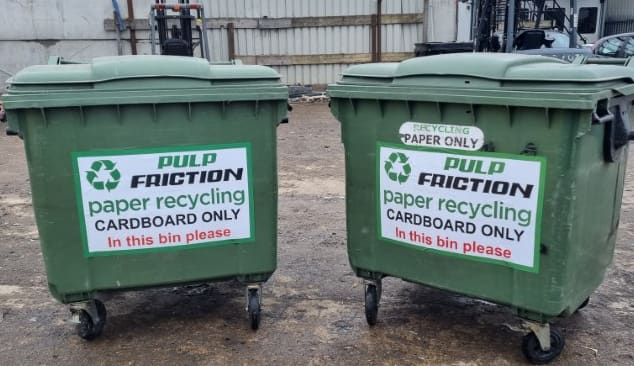
- 1100 litre wheelie bins: one per material, emptied by a rear-end compaction vehicle
- Dolav containers: stackable units that keep grades apart on a production floor
- Open top roll on off containers: several side by side on larger sites: one for cardboard, one for metal, one for general waste
- Flat pack pallet boxes: point-of-production collection that folds away when empty
Certifications
Proof of compliance
Separating waste properly is good practice; carrying it legally is a requirement. Our waste carrier licence (CBDU330287), ISO 9001 and ISO 14001 certificates and Recycling Association membership are all published on our Legal & Certifications page.
ISO 9001
Quality Management
ISO 14001
Environmental Management
Waste Carrier Licence
CBDU330287
TRA Member
The Recycling Association
FAQ
Thamesmead recycling FAQs
Which materials should we separate first?
Usually cardboard and paper, because they're produced in volume and are worth most when clean. Metal is worth separating whenever you have it. We'll advise based on what you actually produce.
Won't separate bins mean more collections?
Not necessarily. We co-ordinate collections so several streams can be picked up together where volume and access allow, and low-volume streams go on a local round rather than getting their own trip.
What happens if a recycling bin gets contaminated?
Contaminated material is worth less and may attract a charge, which is why clear separation matters. If it keeps happening, we'll look with you at where containers are placed and how they're used.
Can you collect from a small unit in Thamesmead?
Yes. We collect from single offices as well as large sites. Smaller addresses are added to an existing local round, so you're not paying for a dedicated vehicle.